Inside the Papal Palace of Avignon, Room by Room
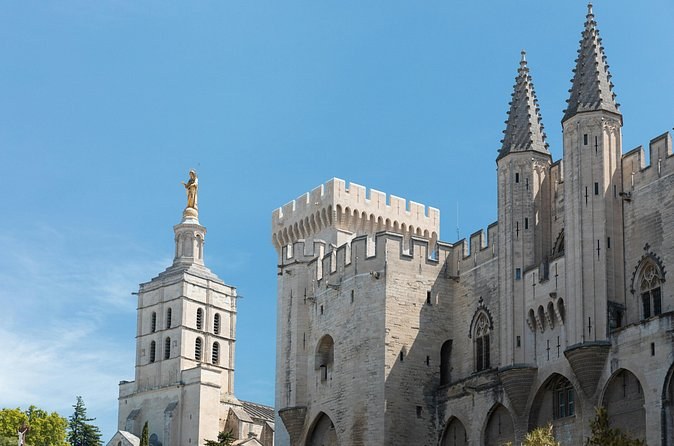
The short answer. The Palais des Papes is two palaces joined: Benoît XII's austere old palace and Clément VI's lighter new one, built between 1335 and 1352. Your ticket opens the 25 rooms on the route, plus the gardens. Allow two to two and a half hours, save your photos for everywhere but the three painted rooms, and look up in the great audience hall. Choose from the Avignon guided tours if you want it explained on the spot.
How the route works
You follow a set route with a free tablet, or with the palace's web app on your phone: join the palace's own Wi-Fi and it opens, with nothing to download, and you find your place by room number. Bring earphones for the films. A new route opened on 1 May 2026 with rooms never shown before, and the works continue until spring 2027, so a room can be closed on your day. The palace's own pages list what is open.
| Room | What it was for | Look for | Photos |
|---|---|---|---|
| Cour d'honneur | The courtyard of the new palace | The festival stage in July | Yes |
| Grande Audience | Papal audiences | The prophets on the last vault | Yes |
| Consistoire | Where the great decisions were taken | Simone Martini's frescoes | Yes |
| Chapelle Saint-Jean | The council's chapel | The two Saint Johns, 1346-1348 | No |
| Grand Tinel | The banqueting hall | Its size | Yes |
| Chambre du Pape | The pope's bedroom | Painted birdcages, most empty | No |
| Chambre du Cerf | Clément VI's study | Hunting and fishing scenes | No |
| Grande Chapelle | Solemn ceremonies | The scale of the nave | Yes |
The courtyard and the great audience hall
You enter by the Cour d'honneur, the courtyard Jean de Louvres closed off with the wing of the great dignitaries. Every July for more than 70 years it has been an open-air theatre seating 2,000 people a performance. The Festival d'Avignon began here in 1947, with Shakespeare's Richard II staged by Jean Vilar.
Below the great chapel lies the Grande Audience, the first and most spectacular work of the new palace. Walk to the far end and look up. In 1353 Matteo Giovannetti painted the vault of the last bay with twenty prophets, kings and patriarchs, each holding a line of scripture. The palace calls it the height of the painter's art, and most visitors walk straight under it.
The council room and its chapel
The Consistoire is one of the two audience rooms, where the great decisions were taken. It now shows the frescoes Simone Martini painted for the porch of Notre-Dame des Doms, brought inside to protect them. Beside it, the Chapelle Saint-Jean was the council's oratory. Its walls and vault tell the lives of John the Baptist and John the Evangelist, painted between 1346 and 1348 by a team Giovannetti led, calmer and more ordered than the chapel above it. It is one of the three rooms where photos are not allowed.
The banqueting hall, and the chapel you must book
Upstairs, the Grand Tinel is the hall where the papal feasts were held, one of the rooms the palace picks out for its size. Beside it is the Chapelle Saint-Martial, where the cardinals deliberated during conclaves. Giovannetti painted it in 1344 and 1345 for Clément VI, with scenes lettered in alphabetical order that read in a spiral from the vault downwards. The whole cycle was restored in 2014, and because the paint is so fragile the chapel opens only by reservation. Ask at the desk or book ahead if you want to see it.
The pope's bedroom and the stag room
The painted rooms sit where the old palace meets the new, at the heart of the pope's private apartment. The Chambre du Pape is covered in vine and oak scrolls on a sky-blue ground, alive with birds and squirrels, probably painted in 1337 or 1338. In the window bays, a row of painted Gothic arches holds cages of different shapes: a few still hold birds, most are empty.
A narrow corridor leads to the Chambre du Cerf, Clément VI's study, painted in 1343 by a French and Italian team. There is not a saint in it. Instead, a continuous forest shows hunting with a decoy and with a ferret, fishing in a pond, people picking fruit in the trees, and the stag hunt that gave the room its name. For a pope's workroom it is a surprise, and it is the room people remember.
The great chapel, the terraces and the gardens
The Grande Chapelle Clémentine held the solemn ceremonies, and its size is the point. From there the terraces open over the city, the Rhône and the whole palace, the best photograph of the visit. Your ticket includes the papal gardens below the walls: Benoît XII's old garden of about 2,000 m², Clément VI's new garden of 1344, and Urban V's orchard of 1365. Last entry to the gardens is 30 minutes before closing, so do not leave them to the end of a late visit.
Hidden highlights most people walk past
- The empty birdcages in the window bays of the pope's bedroom.
- The twenty prophets on the last vault of the great audience hall.
- Simone Martini's frescoes in the council room, moved in from the cathedral porch.
- The pillars of the Roma in the gardens: the gallery Urban V built, later Giovannetti's workshop, pulled down around 1835.
- The animals in the paint: Jean XXII kept bears, lions and camels in cages, and later popes added cranes, ostriches and peacocks, which turn up on the walls of the private rooms.
A step-free visit, and who it suits
The classic route has many stairs and is partly out of reach in a wheelchair. From 1 October the palace runs a step-free route, booked at least 24 hours ahead, on Tuesdays and Fridays from 10 to 12 and Sundays from 2:30 to 4:30. It lasts two hours, starts by lift from the Cour Maria Casarès behind the palace, and takes in the council room, the Chapelle Saint-Jean, the banqueting hall and the upper kitchen. Entry is free for the wheelchair user and one companion; book through the tourist office. The visitor guide has the office's number, and the questions page covers access at the bridge.
Guided, or on your own?
The tablet explains every room, and for many visitors it is enough. A guide earns its place in the painted rooms and the council room, where the story is in the details. Most walks show you the palace from the square; the walk with the palace ticket goes in, from $80 a person, with a glass of Côtes du Rhône at the end. Compare it with the other Avignon walking tours, and read the palace page for prices and hours.
Before you go, read how to plan a first visit; afterwards, the facts behind the popes' century. For the gardens, the weather by month tells you when shade matters.
See the palace with a guide
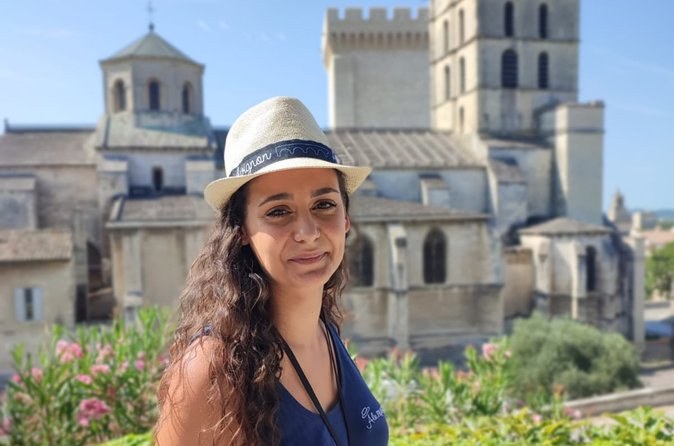
Avignon Walking Tour including Pope's Palace
Three and a half hours from 4 rue de la République with a licensed guide, the palace entrance ticket in the fare and a glass of Côtes du Rhône to finish.
From $80 per person
Check Availability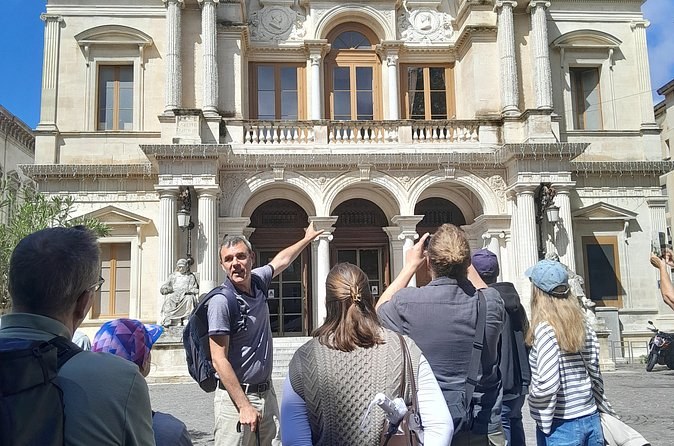
Avignon : walking tour of the must-see sights and secret gems
Two hours from the central post office, twelve short stops between the main squares and the quieter corners, fifteen people at most. Palace and bridge tickets extra.
From $40 per person
Check Availability
Hello Avignon: Private 2-Hour Intro City Walk with Local Guide
A private two-hour walk for your party only from the town hall on Place de l'Horloge, at your pace, with a tasting of a local product.
From $155 per person
Check AvailabilityNext: Book the palace for a morning, go in with the tablet or a guide, and keep the gardens for the last half hour. Every fare sits side by side on Avignon Tours.