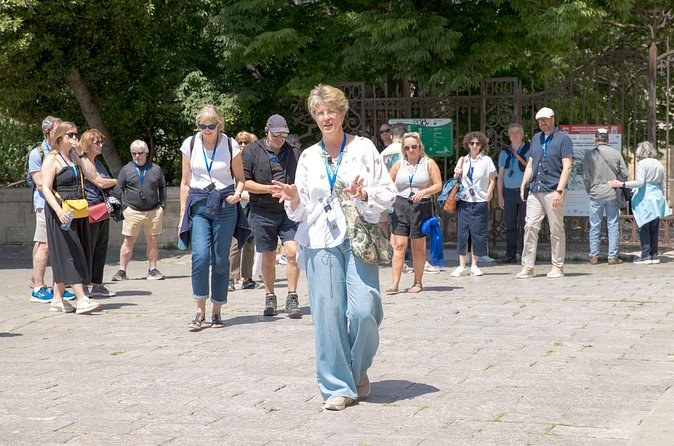
Enchanting Historical Walking Tour in Avignon
Ninety minutes to two hours on foot from Place Crillon, with whisper-box audio (bring 3.5 mm earphones) and two churches on the way. The palace ticket is extra.
From $29 per person
Check AvailabilityAvignon attractions fit inside one walled town, small enough to walk: the palace is 15 minutes on foot from the central station. Two of them charge at the door, and the rest are free. If you want Avignon guided tours, this page shows what each monument is, what it costs and how long it takes, then the sights the day trips reach outside the walls.
The monuments UNESCO listed in 1995 cluster at the north end of the old town, round the palace square; only the ramparts reach further. You can see the palace, the cathedral, the garden and the bridge in a single morning, if you start early.
| Monument | What it is | Entry | Opening |
|---|---|---|---|
| Palais des Papes | The 14th-century papal palace and its gardens | €16 | 9 am-7 pm, 1 March-1 November |
| Pont Saint-Bénézet | The 12th-century bridge that stops halfway across the Rhône | €6 | The palace's seasons; last access 30 minutes before |
| Notre-Dame des Doms | The Romanesque cathedral beside the palace | Free | Closed Mondays from 1 October |
| Rocher des Doms | The garden on the rock, 30 m above the river | Free | A public garden |
| Les Halles | The covered market, about 40 traders | Free | Tuesday-Sunday from 6 am |
| The ramparts | 4.3 km of walls round the old town | Free | Open all year |
| Rue des Teinturiers | The street of water wheels | Free | A street, always open |
The two paid sites share one ticket. The Palais des Papes and its gardens cost €16, the bridge €6, and both together €19.50, valid that day and the next. Under-10s go free at both. The City Pass, from €24, adds the museums and the monuments across the river.
The Pont Saint-Bénézet is the bridge of the song, and it stops in the middle of the Rhône. UNESCO calls it the remains of a 12th-century bridge. You walk out along the deck to the broken end, with the river on both sides.
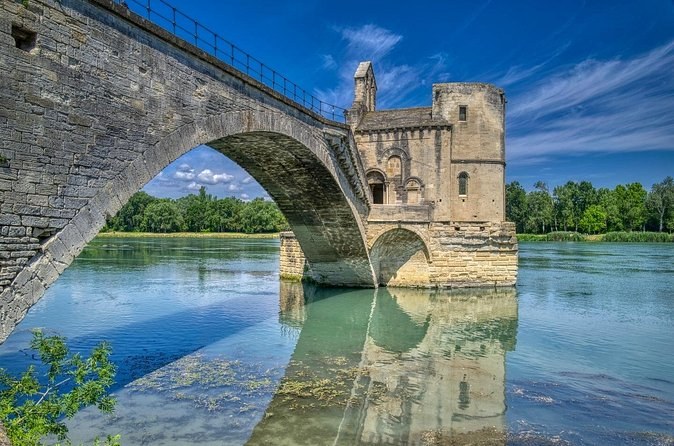
Entry costs €6, or €4 for ages 10 to 17. The visit takes about 35 minutes, with a free audioguide in eleven languages. A lift serves pushchairs and wheelchairs; phone the tourist office before you go to check it is working. Last access is 30 minutes before closing, and dogs on a lead are welcome.
Notre-Dame des Doms is the Romanesque cathedral beside the palace, built in the 12th century and reworked in the 15th and 17th. Its bell tower carries a gilded lead Virgin of four and a half tonnes, placed there in 1859.
Entry is free. Until the end of September it opens 8:30 am to 5:30 pm on weekdays and from 2:30 pm on Mondays. From 1 October it closes at lunchtime and all day on Monday. Steps lead into the nave, and a ramp reaches the square in front. Please keep your voice down during services.
The Rocher des Doms is the rock the town grew from. Its garden rises 30 metres above the Rhône, just behind the cathedral, and it has reopened after months of renovation. From the top you look down on the bridge and across to the island.
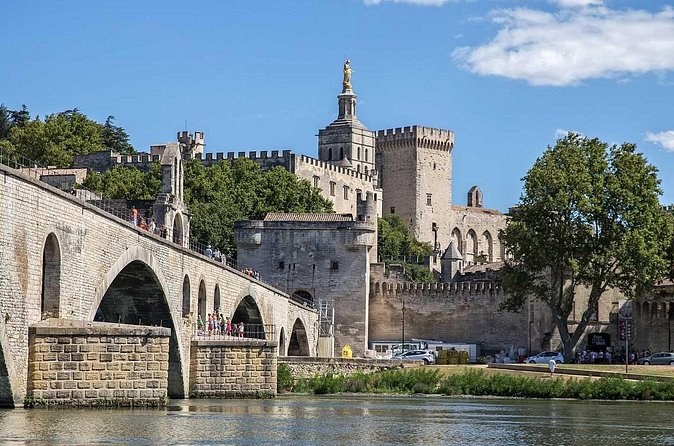
It costs nothing and needs no booking. Come late in the day, when the light falls on the river. You can also reach it from the ramparts above the bridge.
The Petit Palais closes the north side of the palace square. UNESCO records it as the bishops' residence, begun in 1317 and enlarged in the 14th and 15th centuries. Today it is a museum of painting, with Italian work from the Middle Ages.
The square between the two palaces is where many walks begin and end. Your guide stops here for the façade, and some food walks meet on the palace steps. The Palais des Papes car park sits under the square, with lifts up to it.
Les Halles is the covered market on Place Pie, with about 40 traders. It opens every morning from Tuesday to Sunday at 6 am and closes at 2 pm, or 3 pm from Friday to Sunday. The planted wall on its façade is by Patrick Blanc. The food walks all stop inside.
Rue des Teinturiers is a few minutes away. In 1817 it had 23 water wheels driving the printed-fabric trade, and four still turn in the stream. It has been a listed site since 1932, and in July it is the busiest street in town.
The walls run 4.3 km round the old town. Work began in 1355 under Innocent VI, against the bands of mercenaries of the Hundred Years' War, and finished in 1370 under Urban V.
They are open all year and free to see. You can climb onto one stretch through the bridge entrance and follow it up to the Rocher des Doms garden. Elsewhere, you walk the boulevards outside the walls or the lanes inside.
The Île de la Barthelasse sits between two arms of the river, opposite the walls. It is 700 hectares of farms, orchards and towpath, and a free shuttle boat crosses from Quai de la Ligne, near the bridge. The towpath gives you the classic view of the palace and the bridge.
Villeneuve lez Avignon lies on the far bank, beyond the island. The City Pass covers its monuments, including the Fort Saint-André. Innocent VI's Chartreuse stands there too.
Compare the walks inside the walls, from the history walk to the one with the palace ticket.
If you stay two nights or more, a day out of town is the natural second day. The minivan days leave from the walls and cover the sights below. Your fare buys the ride and the guide; most entries are yours to pay.
| Sight | Where | Entry | Which days stop there |
|---|---|---|---|
| Pont du Gard | West, over the Gardon river | Free on foot; parking €9 a car | The Provence highlights days; some put the entry in the fare |
| Fontaine-de-Vaucluse | East, where the Sorgue rises | Free village; a 15-20 minute walk to the spring | The Provence highlights days |
| Sénanque Abbey | North of Gordes, in its own valley | Visits at set times | The lavender day and some Provence days |
| Gordes and Roussillon | The Luberon, east | Free villages; ochre trail 30 or 50 minutes | The Luberon days, half and full |
| Les Baux-de-Provence | The Alpilles, south | Free village | The full Provence days |
| Arles and Saint-Rémy | South, towards the Camargue | Saint-Paul de Mausole in one fare | The Van Gogh half day |
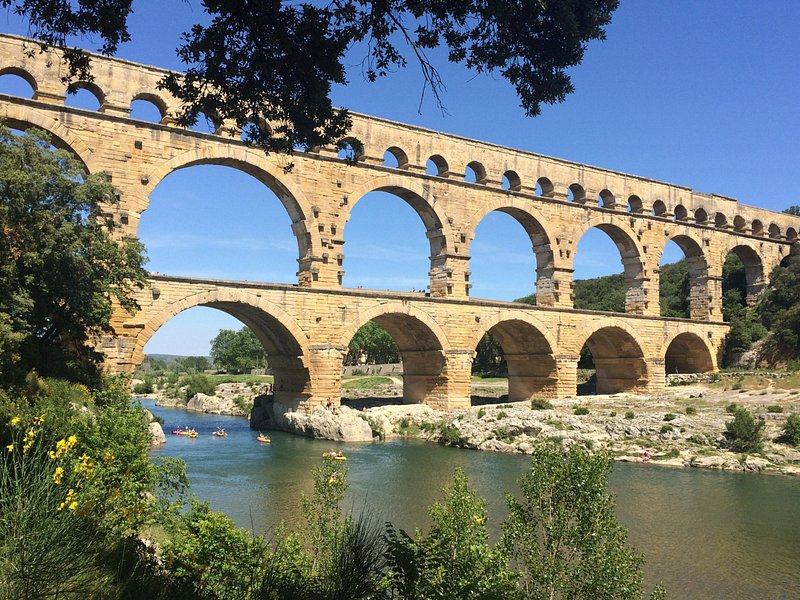
The Pont du Gard is the three-tier Roman aqueduct bridge, nearly 48.77 m high, listed by UNESCO in 1985. The site is pedestrian and free to walk onto; what you pay for is parking, €9 a car a day, and the museum. Some Provence days put the entry in the fare, and you keep the choice of the museum.
At Fontaine-de-Vaucluse the Sorgue rises at the foot of a cliff over 200 m high. The local tourist office calls it the first spring in France by volume. It is a 15 to 20 minute walk from the village on a stony, sloping path, and the last stretch to the chasm stays closed after a rockfall.
Sénanque Abbey was founded in 1148 by Cistercian monks, and monks still live there. You visit at set times, in silence. The lavender day stops for the lavender in front, and the abbey's own entry is not in that fare.
Gordes and Roussillon are both on the list of the most beautiful villages in France. Roussillon's ochre trail takes 30 or 50 minutes, so leave your white clothes at home. The Luberon days give you free time in each.
Every price and opening time above comes from the monument's own page or from Avignon's tourist office, checked 28 September 2026. What each day tour visits comes from its own listing.
Ninety minutes to two hours on foot from Place Crillon, with whisper-box audio (bring 3.5 mm earphones) and two churches on the way. The palace ticket is extra.
From $29 per person
Check Availability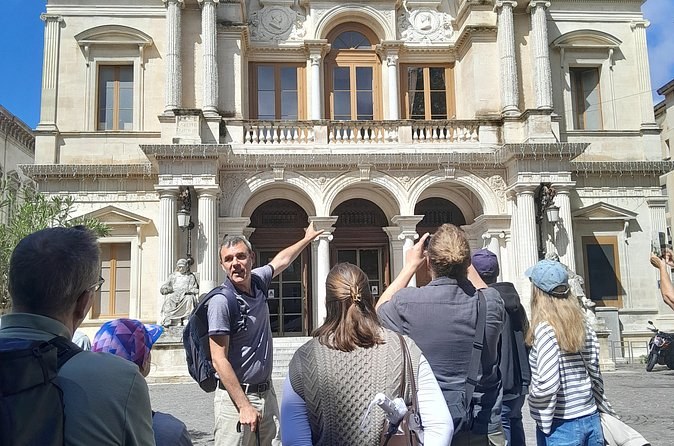
Two hours from the central post office, twelve short stops between the main squares and the quieter corners, fifteen people at most. Palace and bridge tickets extra.
From $40 per person
Check Availability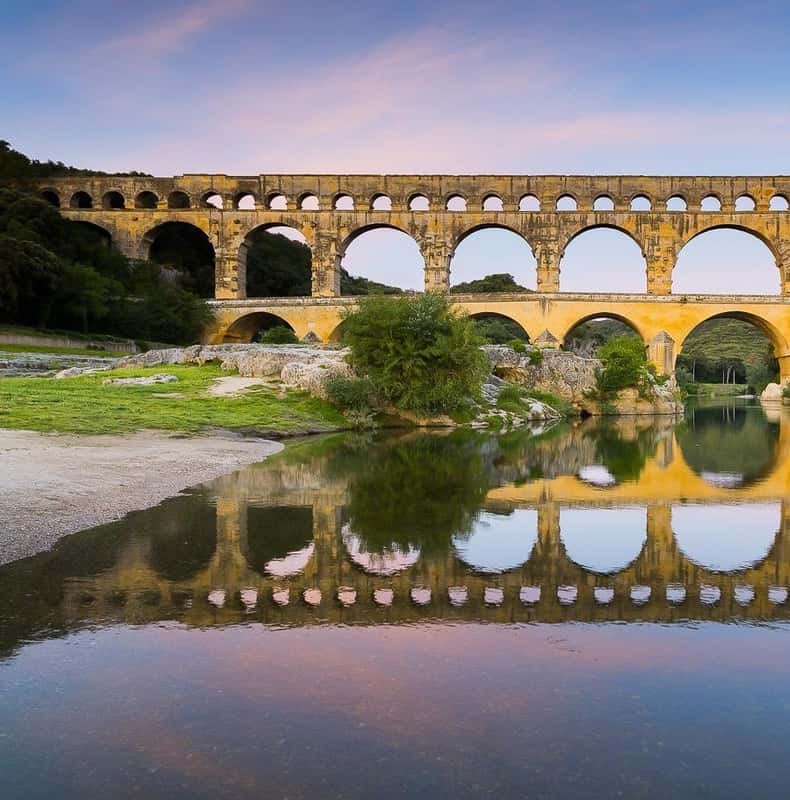
Nine hours from a meeting point given at booking: Gordes, Roussillon, Les Baux, Saint-Rémy and the Roman aqueduct, plus a lavender photo stop in summer.
From $153 per person (minimum 2)
Check AvailabilityNext: go inside on the Palais des Papes, check prices and hours on visiting Avignon, or compare every tour on Avignon Tours.